Tagged: energy
Preparing for Plugin Solar
Correct, a non Moodle related post.. it been over a year since my last post !
I’ve purchased and am awaiting delivery of the Octopus two panel plugin solar kit
In preparation for the arrival of this I’ve been digging into the regulations and safety advice and what if anything do I need in my house to make sure all this is safe.
Only to find a slight issue with my Consumer unit, it has Type AC unidirectional RCDs and not the required Type A bi-directional ones 😦
When the UK updated its electrical regulations to fully support the plug-in solar market, it created a strict safety boundary. To see if my home was compliant, I took off the plastic cover of my consumer unit and looked closely at my RCDs (Residual Current Devices)—the safety switches that flip if there is an electrical fault. There, printed on the front of the switches, was the culprit: Type AC.
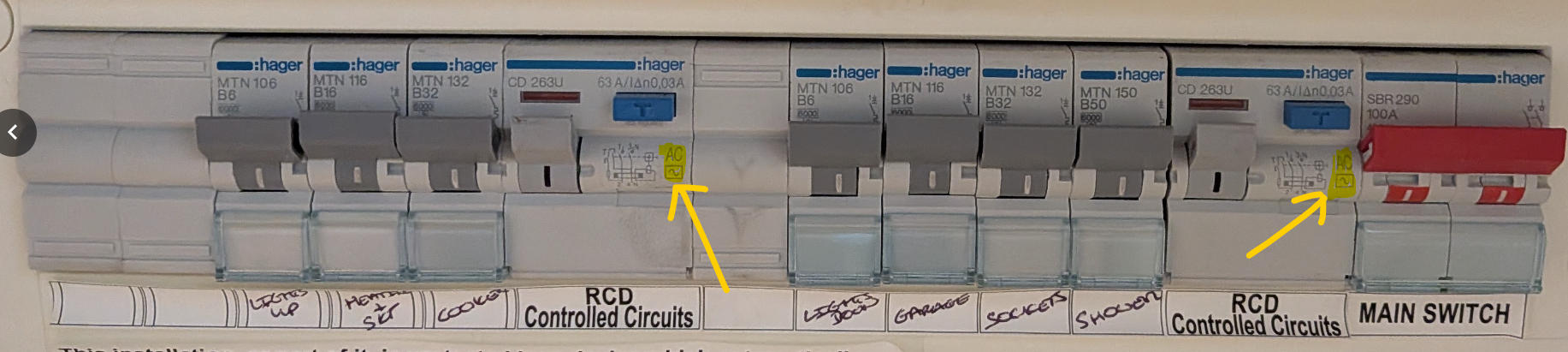
Apparently UK homes built or rewired over the last few decades, Type AC RCDs are the absolute norm. They are perfectly fine for normal household appliances that pull electricity one way out of the grid.
However, they are unidirectional and only look for alternating current (AC) faults. When you introduce a plug-in solar kit, you change the physics of your house. Power is now flowing backward from your socket into the consumer unit. This presents two serious…
Hidden dangers
1. RCD “Blinding” (The Invisible Fire/Shock Hazard)
Solar inverters take the Direct Current (DC) from the sun and turn it into AC for your home. During normal operation, they naturally bleed tiny amounts of smooth DC leakage into the wiring.
Because Type AC RCDs are purely designed for AC, this DC leakage saturates their magnetic core. In the industry, this is called RCD blinding.
- The Danger: Once “blinded,” the RCD is effectively paralysed. If an unrelated appliance on that same ring main (like your washing machine or toaster) develops a dangerous fault later on, the RCD will fail to trip. You lose your shock and fire protection completely without ever knowing it.
2. Device Burnout (The Backwards-Flow Hazard)
Standard RCDs are designed for one-way traffic. When solar sends power backward, it feeds the load side of the RCD instead of the line side.
If the RCD trips or you press the “Test” button while the sun is shining, the internal electronics inside a unidirectional RCD stay live. Testing by electrical safety bodies has shown that this can cause the internal components to overheat, smoke, or catastrophically burn out.
What to do next
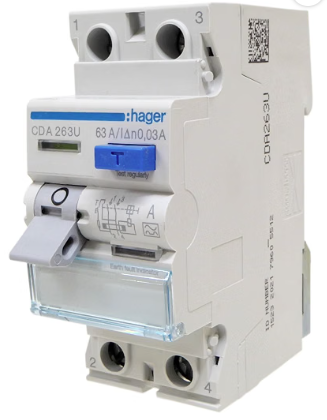
I’ve contacted an electrician, hopefully he’ll tell me what I’ve found that my Hager consumer unit is backward compatible and I can get one or two (if recommended) Type A RCDs to replace these Type AC ones, it seems to me the ‘quite dangerous’ untrained AI electrician that I need to replace both of them for Hager CDA263U 2 Pole 63A 30mA Type A RCD‘s, no fear I aint doing this myself!
This in affect means more time to gain back my outgoing spend on the panels..which is a bit disappointing 😦
But the eventually pull of free electricity is a greater draw.. 🙂
You might be asking why not just buy full roof solar … reason one which I have not got passed, my roof is roughly 55 years old, built in 1971, meaning an extra expense is probably required first on a new roof before I go down that path!
I’ll let you know how it goes.

